How Does Audio/Visual Entrainment Work?
Entrainment is the act of synchronizing two individual sources. For example, if you start tapping your foot to match the beat of your favorite song—often without even realizing it—you are experiencing the power of entrainment on the subconscious.
Why Does Entrainment Matter?
Audio-Visual Entrainment (A.V.E.) uses rhythmic light and sound therapy to help the mind play "follow the leader." By guiding the brain out of dysregulated, stuck patterns and into balanced frequency ranges, users can feel calmer and more relaxed—or stimulated and focused when they need a cognitive boost. Entrainment can support stress resilience, mood, sleep quality, memory, focus, and peak performance.
The 5 Human Brainwave Types & Why They Matter
The human brain operates across 5 primary brainwave bands: Delta, Theta, Alpha, Beta (including SMR), and Gamma. Our ability to shift smoothly between them determines how well we sleep, focus, manage stress, and process information.
The slowest brainwaves, associated with the deepest levels of relaxation and restorative, dreamless sleep ("Delta for Deep"). Adequate Delta production during sleep helps rejuvenate the body and brain.
- High waking levels: Head injuries, brain fog, severe attention issues, fatigue.
- Low nighttime levels: Non-restorative sleep, inability to rejuvenate body.
- Entrainment benefits: Persistent ache relief, reduced stress, deep restorative sleep cycles.
Associated with deep meditation, twilight sleep, vivid imagery, and emotional processing. Includes the 7.83 Hz Schumann Resonance (Earth's natural electromagnetic frequency).
- High waking levels: Daydreaming, inattentiveness, tuning out, low mood.
- Low levels: Stress, poor emotional awareness, inability to unwind.
- Entrainment benefits: Deep meditation, trauma reprocessing, stress release, sleep transition.
The "frequency bridge" between conscious thinking (Beta) and the subconscious mind (Theta). Promotes calm, relaxed awareness and visualization. When stressed, "Alpha blocking" occurs as excessive Beta suppresses Alpha.
- High frontal levels: Rumination, low motivation, trouble shifting into critical thinking.
- Low levels: Stress, tension, cravings/addictions, restlessness.
- Entrainment benefits: Calm relaxation, stress relief, light meditation, balance.
SMR (12–15 Hz) is "relaxed focus"—calm body, alert mind. Mid-Beta (15–18 Hz) powers conscious thought, reading, logic, and task completion.
- High levels (22+ Hz): Worry, anxiety, muscle tension, hyperarousal, insomnia.
- Low levels: ADD/ADHD focus challenges, mental fatigue, low motivation.
- Entrainment benefits: Sustained concentration, reading/study focus, better sleep architecture (SMR).
Gamma waves bind information across different areas of the brain and support higher-order cognition, working memory, and mental clarity. Published studies from MIT and other institutions have investigated 40 Hz light and sound stimulation for memory and cognitive support. Note: Because Gamma is very energizing, limit Gamma sessions to 2–3 times per week at first and do not use close to bedtime.
4 Important Things to Know About Entrainment
1. Entrainment Guides Normalized Brainwave Frequencies
Many neurological symptoms stem from dysregulated brainwave patterns—for example, elevated frontal Beta can produce feelings of anxiety. Entrainment gently leads the brain out of elevated or sluggish frequencies and into normalized rhythms so associated symptoms can subside.
2. The Brain Entrains Easiest Near Its Dominant Frequency
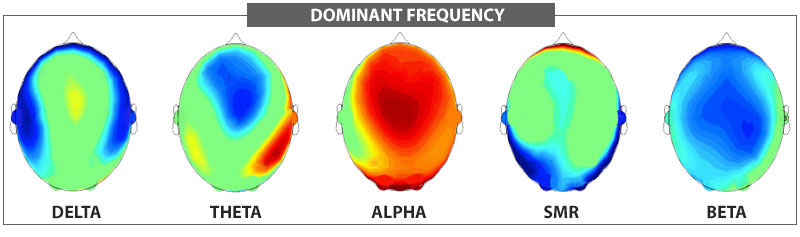
In a healthy brain, frequencies operate at balanced speeds. When a QEEG brain map shows a specific band is dominant (such as Alpha in the diagram), bands adjacent to that dominant frequency (Alpha, Theta, or SMR) entrain most easily.
- Delta Slow: Memory issues, slowed cognitive processing, head injury
- Theta Slow: Memory recall challenges
- Alpha Slow: Tired brain, low energy, low self-esteem
- Beta Slow: Slow processing speed
- Delta Fast: Sleep issues, memory, inflammation
- Theta Fast: Low energy, low self-esteem
- Alpha Fast: Restlessness, high adrenal activity
- Beta Fast: Worry, stress, chronic hyperarousal
3. Entrainment Stimulates the Whole Brain
While clinical neurofeedback places sensors on specific scalp sites, Audio-Visual Entrainment stimulates the visual and auditory cortex, sending rhythmic signals across the entire brain. Bi-hemisphere sessions further allow independent left and right visual-field frequency stimulation to address left/right asymmetries.
4. Use Ramping / Suppression Sessions Instead of Reinforcing Elevated Waves
If someone already has globally elevated Delta during the day, you do not want to stimulate more daytime Delta. Instead, use a Ramping / Suppression session (Folder 05 on Nexus / Folder 08 on Nexus Plus) that starts near the elevated frequency and gradually ramps up or down to lead the brain out of the excess band.
What Sessions Are Best For Me?
Want an instant interactive match? Use our Symptom & Session Finder, or review the common goals below:
Goal: Improve Mood & Emotional Energy
Low mood is often linked to excess slow Alpha/Theta in the left hemisphere. SMR, Beta, and Asymmetry sessions help restore alert, positive engagement:
- Nexus Plus: Peak Performance #01 In The Zone, Gamma #04 Gamma Get Up And Go, Disentrainment #02 Delta-Beta Music, SMR #02 Random SMR, Ramping #08 Alpha Asymmetry
- Standard Nexus: Relaxation #09 SMR For Mood, Bi-Hemisphere #04 Alpha Asymmetry, Bi-Hemisphere #02 SMR Focus and Mood, Energizing #07 Uplifting
Goal: Reduce Stress, Worry & Tension
Stress and tension involve excess fast Beta above 18 Hz. Ramping Beta down into Alpha or 7.83 Hz Schumann helps quiet the stress response:
- Nexus Plus: Ramping #07 All Beta Suppress, Bi-Hemisphere #01 Alpha Relax Left, SMR #05 Motor On Down, Schumann #01 Aurora Borealis, Mental Health #15 Zone Out Meditation
- Standard Nexus: Ramping #06 Beta Suppress, Relaxation #07 Motor on Down, Relaxation #06 Alpha Relax 10Hz, Relaxation #03 Zone Out
Goal: Reduce Afternoon Fatigue & Sharpen Focus
Daytime tiredness or daydreaming usually reflects excess Theta or slow waves. Disentrainment, SMR, and Beta/Gamma sessions wake up focus:
- Nexus Plus: Disentrainment #01 Refocus, Disentrainment #02 Delta-Beta Music, Alternating #04/05 Cognition, Peak Performance #04 Gamma Get Up And Go
- Standard Nexus: Wellness #01 Refocus, Wellness #02 Randomizer, Wellness #09 Cognition, Energizing #05 Cup of Joe
Goal: Fall Asleep Easier & Get Deeper Rest
Use pre-bedtime Alpha/Schumann sessions before getting into bed to quiet racing thoughts, or place your glasses on the nightstand for all-night Delta sleep loops:
- Pre-Bed Wind-Down: Bedtime #01 Alpha Before Bed / Overactive Minds, Bedtime #03/#04 Calming, Bedtime #04/#05 Quick Nap (Heavenly Choir)
- In-Bed Delta Sleep: Bedtime #05/#06 Induction Night Sounds, #07 Delta Pink Noise, #08 Delta Rain / Nighttime Recovery